
Eco-friendly weddings: waste-free celebrations with low environmental impact
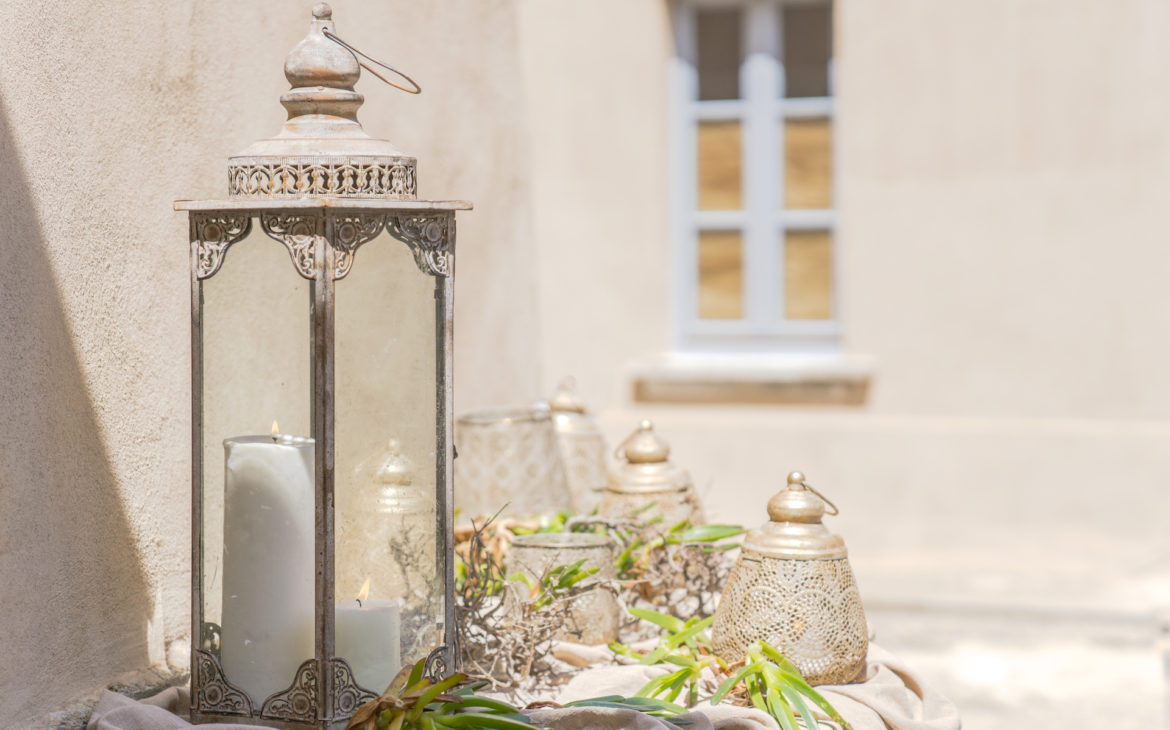
Today, public awareness of environmental issues is very high. As the world becomes increasingly focused on protecting the environment, the wedding industry, too, adapts to this change and wedding planners meet the rising demand with events and solutions in line with the principles of sustainability. Eco-friendly weddings are a growing trend. Many couples want their special day to be respectful of nature, and opt for wedding celebrations that have a reduced environmental impact. Compared to a few years ago, weddings are definitely bucking the trend and becoming more and more sustainable. Couples prefer simplicity, authenticity, and respect for the environment. The essence of “eco-friendly weddings,” that is to say zero-waste, low-impact weddings, is based on applying the concept of sustainability to every single feature of the event. This means that every detail, from the selection of the venue to the attire, from the decorations and set-up to the catering, is carefully considered in terms of its environmental impact. The keywords are “reduce, reuse, and recycle”. Despite this being a recent trend, I had already met couples who were very sensitive to this issue many years ago: they explicitly asked me not to use flowers and rice, opting, instead, for other types of materials and seeds. I vividly remember the decor of one specific wedding where I used natural fabrics, dry branches, lanterns, cushions, and Carpobrotus edulis, commonly known as iceplant or Hottentot-fig, a succulent shrub widely naturalized in the Mediterranean basin that has long, woody stems which grow along the ground.
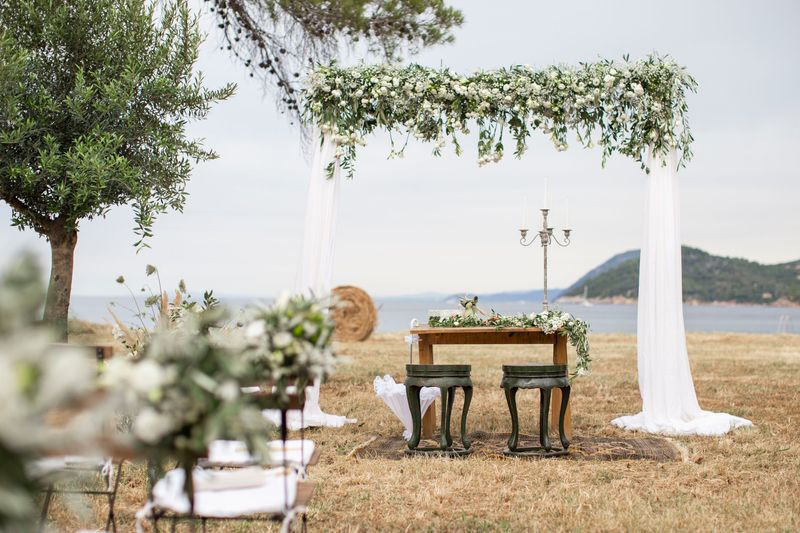
However, this was not the only case. I used to call this style natural-chic because I used native plants, branches polished by the sea that I found on the beach, or, particularly for table settings, family decor items and heirlooms. The result was natural and “effortless”, and, without knowing it, I already preferred a simple yet effective style. But let’s get back to eco-friendly weddings: here are some tips and ideas for suitable venues, invitations, sustainable wedding favors, menus featuring locally sourced products, natural decor, and wedding dresses.
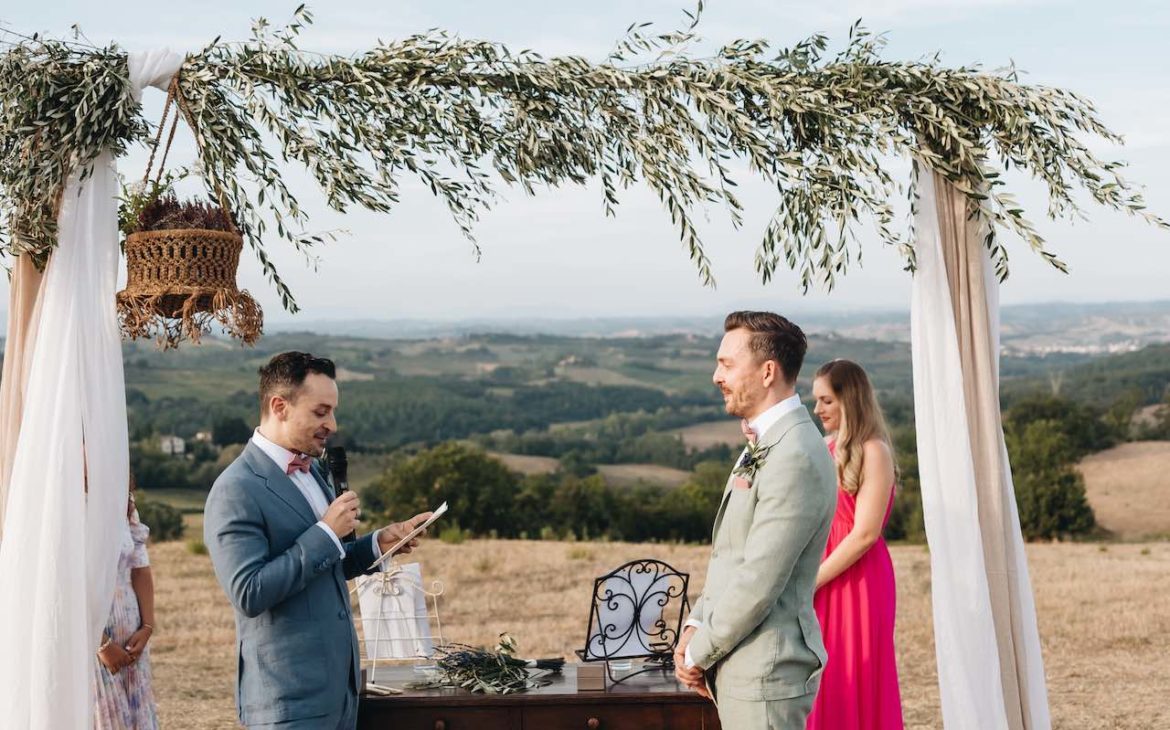
Ideas and suggestions for an eco-friendly wedding in Tuscany. And why you should hire a wedding planner…
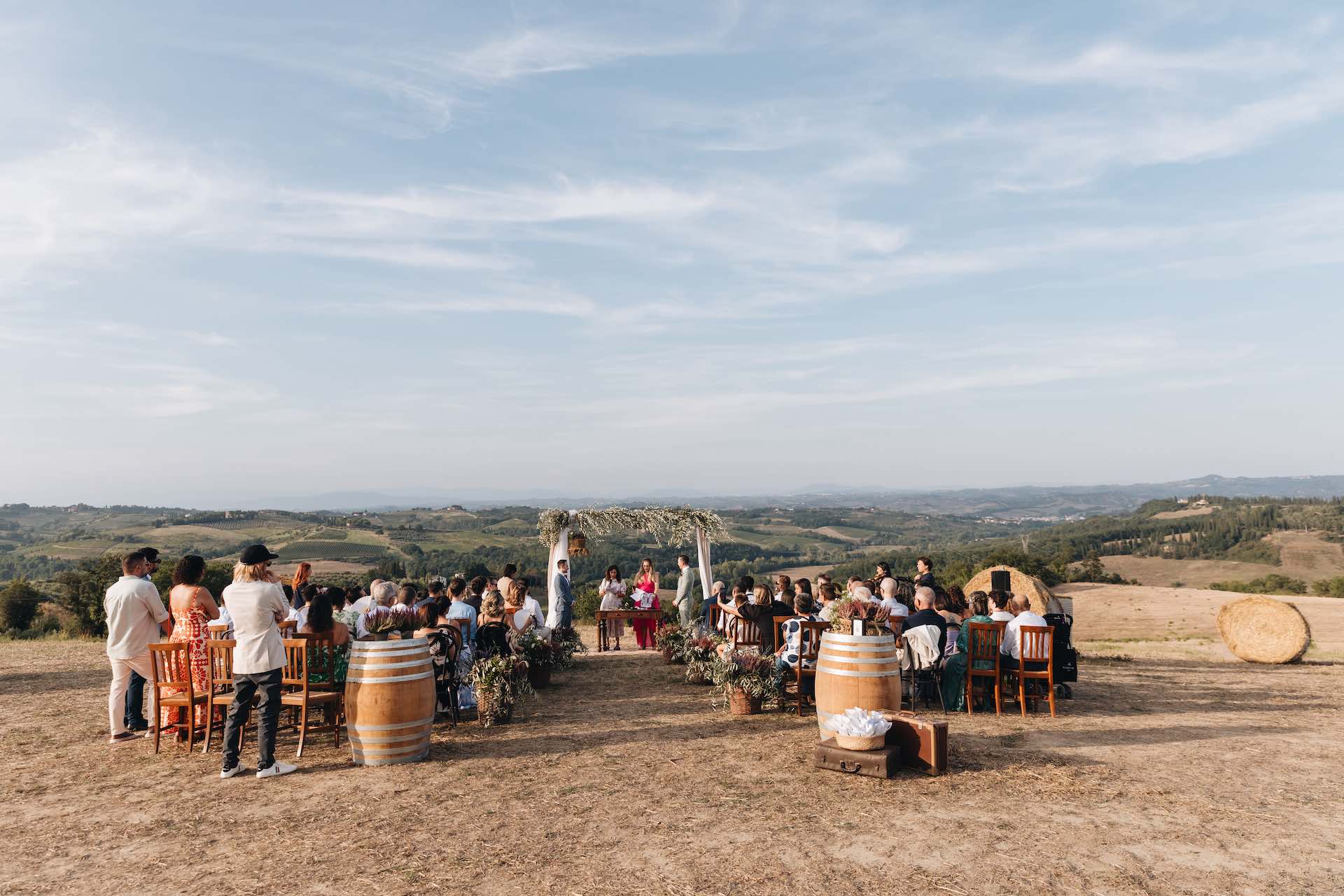
Planning an eco-friendly or sustainable wedding is no easy task. This is why it is important to rely on a wedding planner to source and select suppliers and venues that respect a couple’s environment-conscious values. There are several key factors to keep in mind when organizing an eco-friendly wedding in Tuscany: 1) find a venue that adheres to the principles of eco-sustainability; 2) choose a menu prepared with locally-sourced products (to avoid pollution); 3) plan for proper waste sorting during and after the event; 4) opt for wedding favors, invitations, place cards, and a tableau de mariage made with recycled materials; 5) select suppliers that are based as close to the wedding venue as possible. In my opinion, Tuscany is an ideal setting for a sustainable, eco-friendly wedding celebration: the wedding venues nestled in the iconic emerald-green hills of my beautiful region are all fascinating and evocative. But there’s more: being immersed in nature, nearly all venues favor eco-sustainability by offering cuisine made with locally sourced ingredients, and organic products and decor. The most popular Tuscan cities include Florence, Siena, and Lucca, as well as Volterra, Arezzo, and Pisa: real open-air museums, they are perfect for romantic, and sustainable, weddings. Plus, the typical streets and winding alleys, medieval churches and palaces provide ideal backdrops for your wedding photos. Which means that you can avoid traveling too far from the reception venue and thus reduce the pollution caused by transportation. The same goes for Tuscany’s medieval towns, such as Montalcino, San Gimignano, Monteriggioni, and Pienza, awe-inspiring gems brimming with art and history that one can explore entirely on foot.